
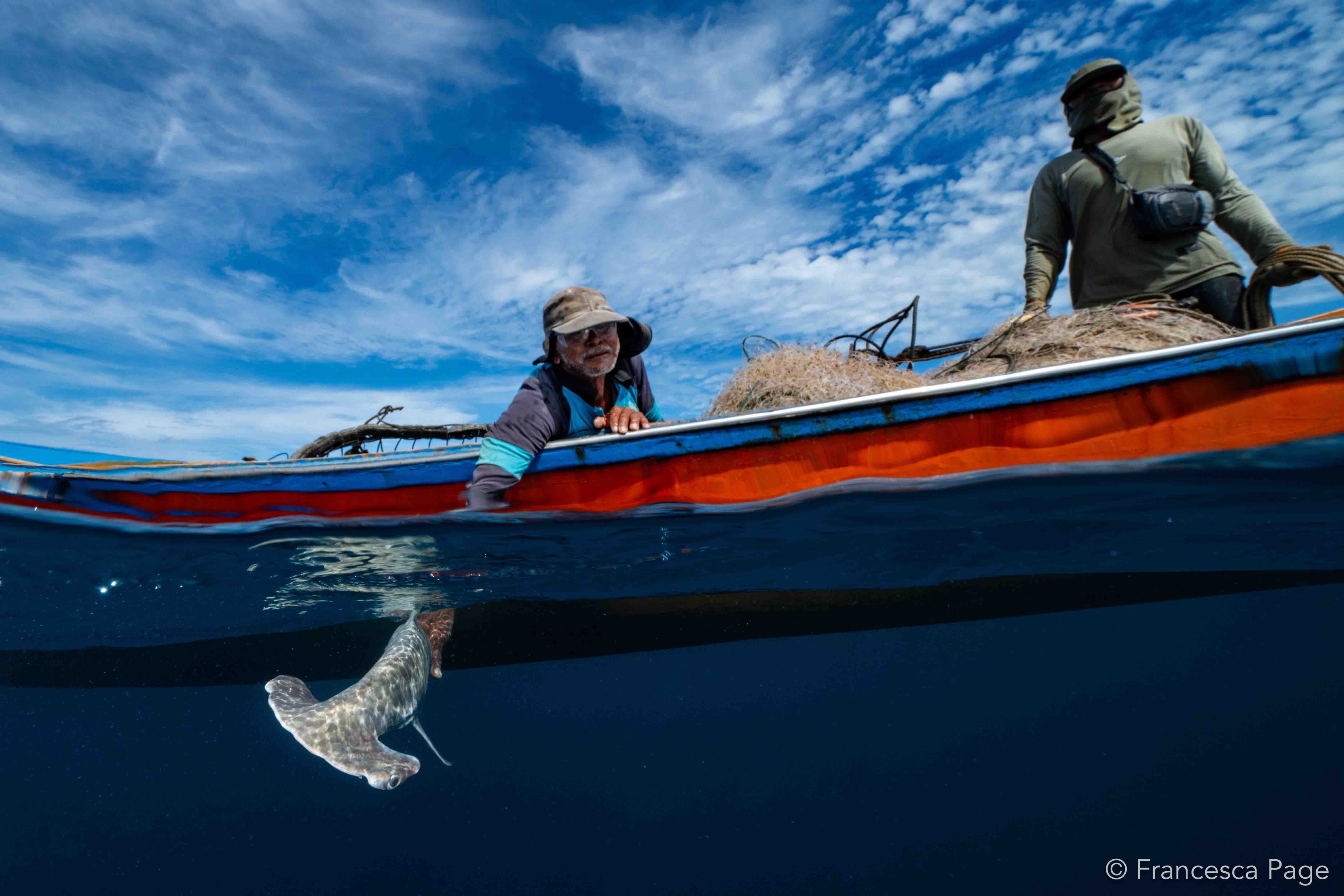
In Aceh Province, we are working collaboratively with 115 small-scale fishers operating 52 vessels across five coastal communities: Lhok Rigaih, Lhok Patek, Lhok Keuluang Daya, Lhok Babah Nipah, and Lhok Kruet Pulo Raya. These fishers typically conduct fishing trips lasting between one to three days, using primarily gillnets and handlines. Their main targets are economically important pelagic and demersal fish species, including snapper (Lutjanus spp.), grouper (Epinephelus spp.), and other reef-associated and migratory species that support local food security and income.
Although sharks and rays are not directly targeted in these fisheries, they are frequently caught as bycatch. To address this issue, we are implementing innovative bycatch reduction strategies, including gear-swap and pay-to-release programs. In Aceh, the Pay-to-Release initiative offers financial compensation to fishers who voluntarily release Critically Endangered species such as the hammerhead shark (Sphyrna lewini, locally known as Yee Rimbah) and wedgefish (Rhynchobatus sp., locally known as Yee Baji) when they are caught in gillnets or on handlines. Fishers are typically paid around USD $5–8 per individual shark or ray released—an amount comparable to what they would have earned by keeping and selling the species. Payments are made based on verified video evidence and are distributed among crew members of participating vessels. Fishers commonly use the funds to purchase household necessities or pay for their children’s education. This program provides a mutually beneficial solution: fewer endangered sharks and rays are landed, and small-scale fishers and their families maintain economic stability.
To strengthen science-based conservation in this data-deficient region, we also deploy Baited Remote Underwater Video Systems (BRUVS) to gather information on shark and ray populations. This non-invasive monitoring tool helps improve our understanding of species presence, behavior, and habitat use, which in turn supports more effective management and protection strategies. BRUVS are deployed both within marine protected areas (MPAs) and outside them, covering a range of ecological zones. Within MPAs, we focus on core protection zones (zona inti) such as Lhok Keluang, Lhok Babah Nipah, and Lhok Rigaih—areas where fishing and extractive activities are prohibited. To provide a comparative baseline, we also deploy BRUVS in surrounding non-MPA zones, including Lhok Kuala Daya, Lhok Kuala Unga, Lhok Lambeusoi, Lhok Kruet, and Lhok Patek. This dual approach helps assess the effectiveness of MPAs and informs adaptive management for broader marine conservation efforts across the region.

In addition to ecological efforts, we support local women by providing training in traditional kasab weaving techniques. A total of 10 female fishers have been trained by expert artisans from Aceh Jaya, helping to ensure the authenticity and quality of the craft. By incorporating shark and ray motifs into their kasab creations, these women are not only preserving their cultural heritage but also raising awareness about marine biodiversity and conservation. This community-based approach helps foster stewardship and broadens participation in sustainable fisheries management, making women active contributors to both cultural and ecological resilience
